Skechers Mobile App Redesign
Skechers had an app. What they didn't have was a reason for customers to keep opening it.
Retail & E-commerce
Proposal Design
Role
Product Designer
Timeline
2 weeks
team
Solo Project
platform
Mobile (iOS & Android)

The Real Problem
Skechers has had a mobile app since 2016, but having an app and having a competitive app are two very different things.
Their biggest rivals had turned digital into a genuine revenue engine. Nike's customisation feature was driving loyalty and commanding premium pricing. Adidas had seen a 53% surge in online sales, with digital experience cited as the primary driver. Puma was creating daily engagement through fitness tracking and rewards well beyond the point of sale.
The Skechers app, by comparison, functioned primarily as a mobile storefront. It didn't give users a reason to come back when they weren't actively shopping. There was no personalisation, no loyalty loop, no lifestyle integration.
The gap wasn't the absence of an app it was the absence of a strategy behind it. With 78% of consumers preferring to purchase through a brand app over a mobile website, the question wasn't whether Skechers needed to be on mobile. They were. The question was whether their app was actually working for the business or just existing.
Finding the Fix
I started with a structured competitor analysis to understand what the market now expected as a baseline and where the real differentiation opportunity sat.
The pattern across Puma, Adidas, and Nike wasn't about any single feature. It was a shared strategic move: the most successful footwear brands had shifted their apps from checkout tools into daily habits. Their apps gave users a reason to open them on days they weren't buying anything and that engagement was directly converting into higher retention and purchase frequency.
I applied the Delta 4 framework to map where the Skechers app experience fell significantly short of what competitors and consumer expectations had already established as standard. Six clear opportunity areas emerged: fitness and activity integration, AR-powered fit assistance, sustainable product discovery, community and events, visual search, and a shoe recycling programme.
The filter I applied to each was simple: does this either increase purchase confidence, drive repeat engagement, or build brand loyalty? Features that didn't clearly answer yes didn't make the proposal.

What I Designed
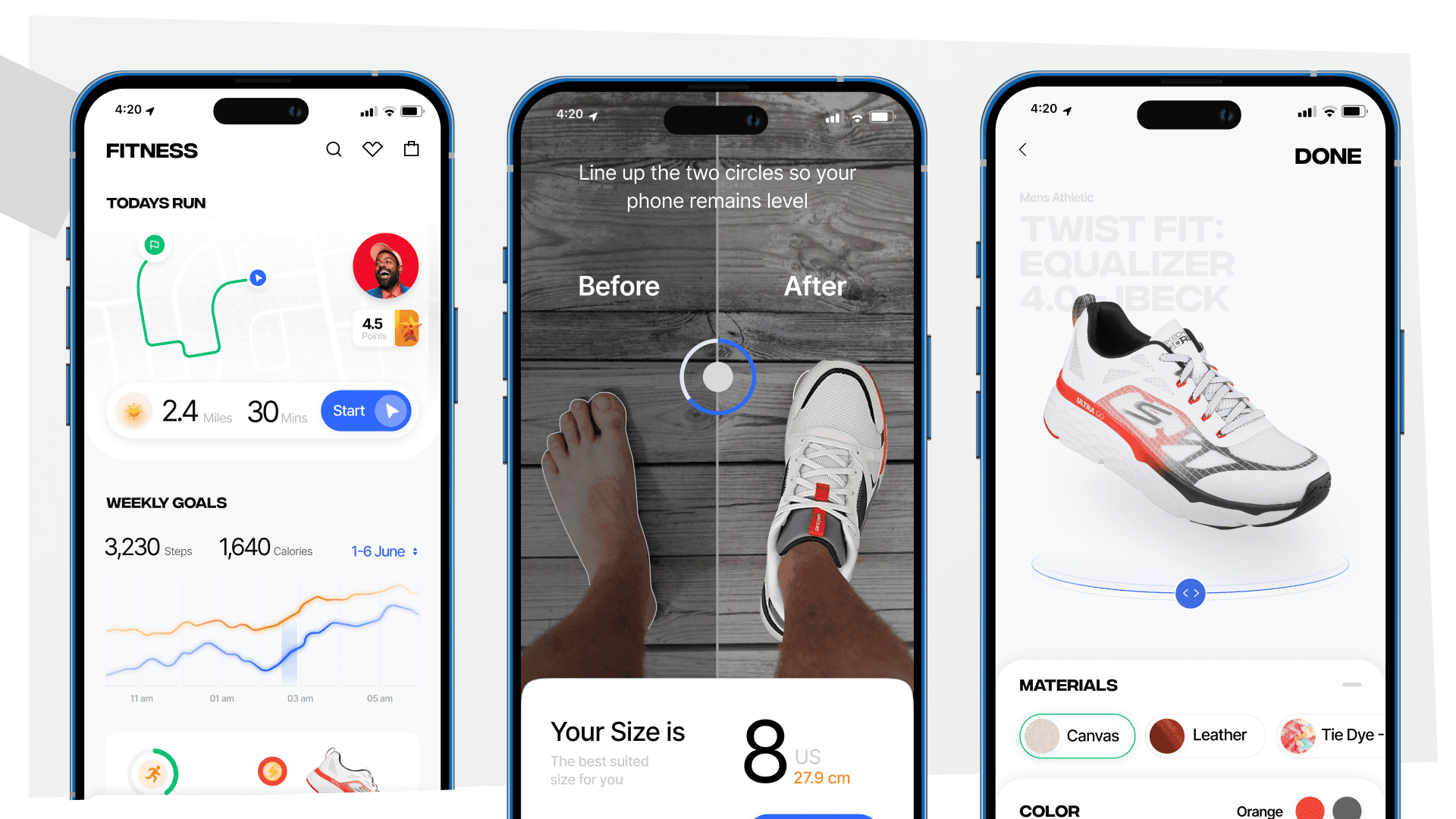
Fitness & Rewards Steps taken in Skechers shoes — tracked through the app or a connected smartwatch — convert into redeemable reward points. This creates a daily reason to engage with the app that sits entirely outside the purchase journey, but feeds directly back into it. The app becomes part of the user's routine, not just their shopping behaviour.
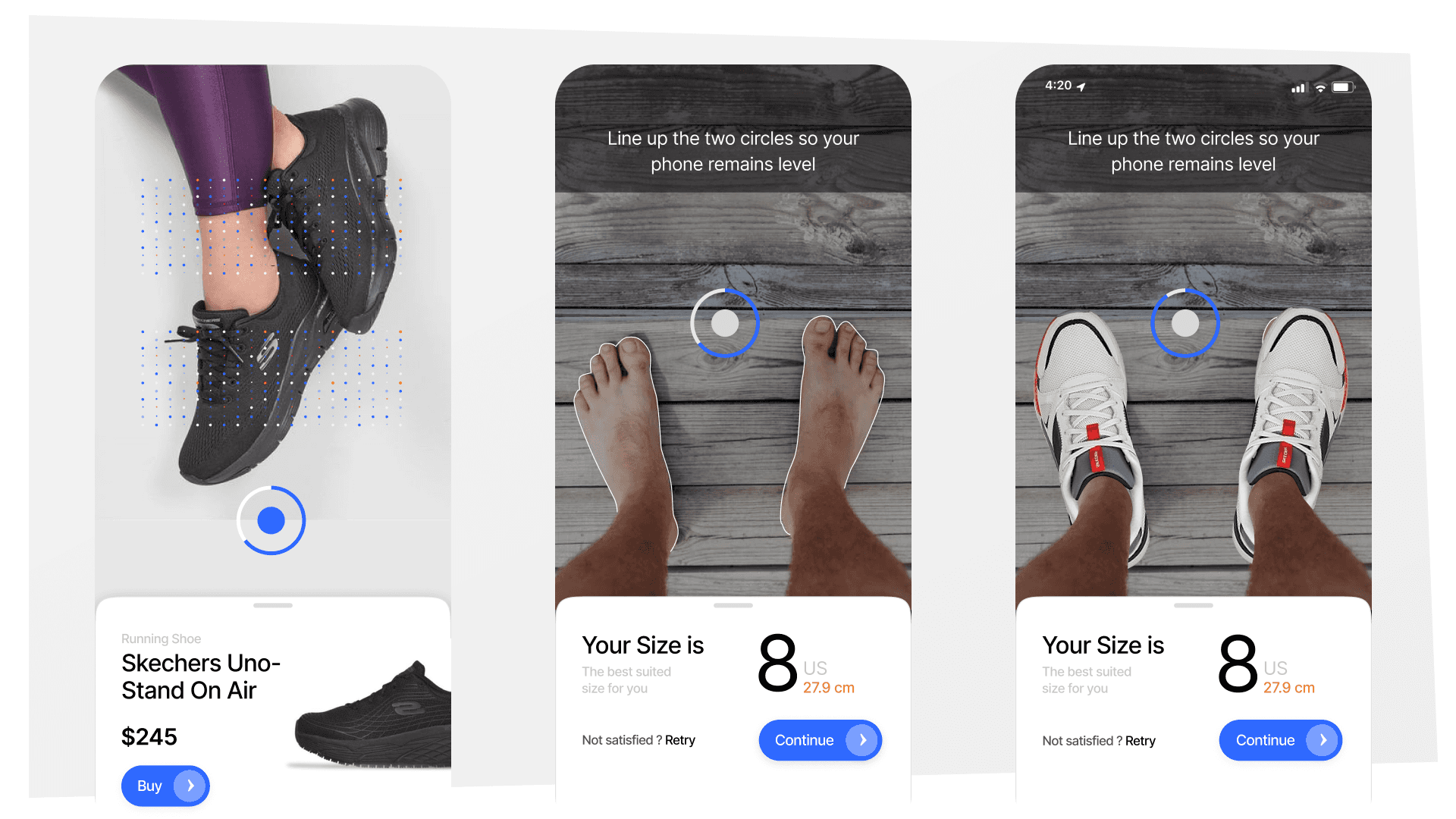
AR Foot Scanning for Perfect Fit Using the phone camera, the app scans the user's foot and recommends the right size and model fit — directly addressing one of the most persistent barriers to online footwear conversion: uncertainty about fit. Users can also compare fit across models within the app before committing to a purchase.
Sustainable Product Filter A dedicated filter to surface shoes made from renewable or recycled materials. As sustainability becomes an active purchase driver — particularly among younger demographics — this gives Skechers a values-led differentiator that competitors haven't fully claimed.
Community Hub & Events An events section where users can discover and register for sponsored marathons, fitness events, and brand activations. Participation earns reward points, creating a closed loop between physical brand engagement and in-app incentives.
Visual Search Users can photograph any shoe they encounter — on the street, in a magazine, on social media — and instantly surface the closest Skechers match. This opens a new discovery channel that bypasses traditional search entirely.
Recycle & Exchange Embedded within the product detail page, users can exchange old Skechers shoes for credit toward their next purchase. It drives repeat acquisition, reinforces the sustainability positioning, and gives loyal customers a tangible financial reason to stay within the brand ecosystem.
Shoe Customisation — The IKEA Effect Users can configure their own shoe from scratch: colours, strap styles, sole type, materials — then place a custom order directly through the app. The psychological principle here is deliberate: when users build something themselves, their perceived value of it increases significantly. This is a loyalty mechanism disguised as a product feature.
What This Could Unlock
This was an unsolicited proposal so traditional post-launch metrics don't apply. But the business case was embedded into every design decision from the start.
The AR fit feature targets the primary reason consumers abandon online footwear purchases: size uncertainty. Solving that single friction point has a direct and measurable impact on conversion rate. The fitness and rewards loop creates daily active engagement without a sustained marketing spend to maintain it. The recycling feature structurally converts one-time buyers into repeat customers with a built-in return trigger.
Taken together, these features represent a strategic repositioning of the Skechers app — from a mobile extension of their website into a lifestyle platform. That is precisely the shift that drove measurable, sustained revenue growth for their closest competitors. The opportunity for Skechers isn't to catch up it's to move faster than the brands that got there first, by going further.
Documentation time dropped from 15-20 minutes to 7-10 minutes. Support tickets about lost work decreased by 78% in the first month. In a follow-up survey, 89% of therapists said the new system was easier or much easier than before.
But my favorite feedback was qualitative
'This is exactly what I needed I can finally see where I am.'
'I haven't lost a note since the update. Game changer.'
'It actually feels like someone asked us what we needed.'
Zero people requested to go back to the old version, which felt like the real success metric.
What I Had to Work With
No client brief, no internal data. This was entirely self-initiated. All problem framing was built from publicly available competitor performance data, industry benchmarks, and consumer behaviour research. There was no access to Skechers' conversion figures, user research, or product roadmap.
Working within a brand I didn't own. Every design decision had to feel authentically Skechers — not my personal aesthetic applied to their identity. The visual language, product logic, and feature positioning all had to be credible enough to place in front of a global brand team without adjustment.
Self-imposed scope discipline. Without external constraints, the biggest risk was building too broadly. The Delta 4 framework served as the check on that if a feature didn't represent a meaningful step-change over the existing experience, it didn't earn its place in the proposal.
What I'd Do Differently
I'd design the onboarding flow. The proposal focused heavily on feature depth, but the moment a user opens the app for the first time and how quickly they understand its value is arguably the most critical experience I didn't address. A strong onboarding sequence would have strengthened the business case considerably.
I'd also pressure-test the AR foot-scanning feature against real device constraints earlier in the process. It's the most differentiating feature in the proposal, and its viability depends on ARKit and AR Core capabilities that vary meaningfully across device generations and price points particularly relevant in markets like the GCC where mid-range Android devices are dominant.
What I Learned
Diagnosing the right problem is the most important design decision. Framing this as a strategic competitiveness gap rather than a visual redesign gave every feature a clear business rationale. That framing is what separates a product proposal from a mood board.
The most useful thing competitor analysis can surface is the underlying strategy, not the feature list. Puma, Adidas, and Nike had very different apps. But they shared one move: turning the app into a daily habit rather than a checkout destination. That single insight shaped the entire direction of this proposal.
Unsolicited work requires you to be your own most critical stakeholder. Without a client brief to anchor decisions, every choice needed a rationale that could hold up in a room with a commercial director. That discipline — justifying design decisions in business terms — made the output more rigorous than most briefed projects I've worked on.