Kuwait Design System
The design infrastructure Kuwait's digital government needs to deliver Vision 2035 starting now.
Design Systems · Gov UX ·
Kuwait Vision 2035
Role
UX Designer · Design System Architect
Timeline
8 weeks
team
2 Enginners, 1 PM, me
platform
Web
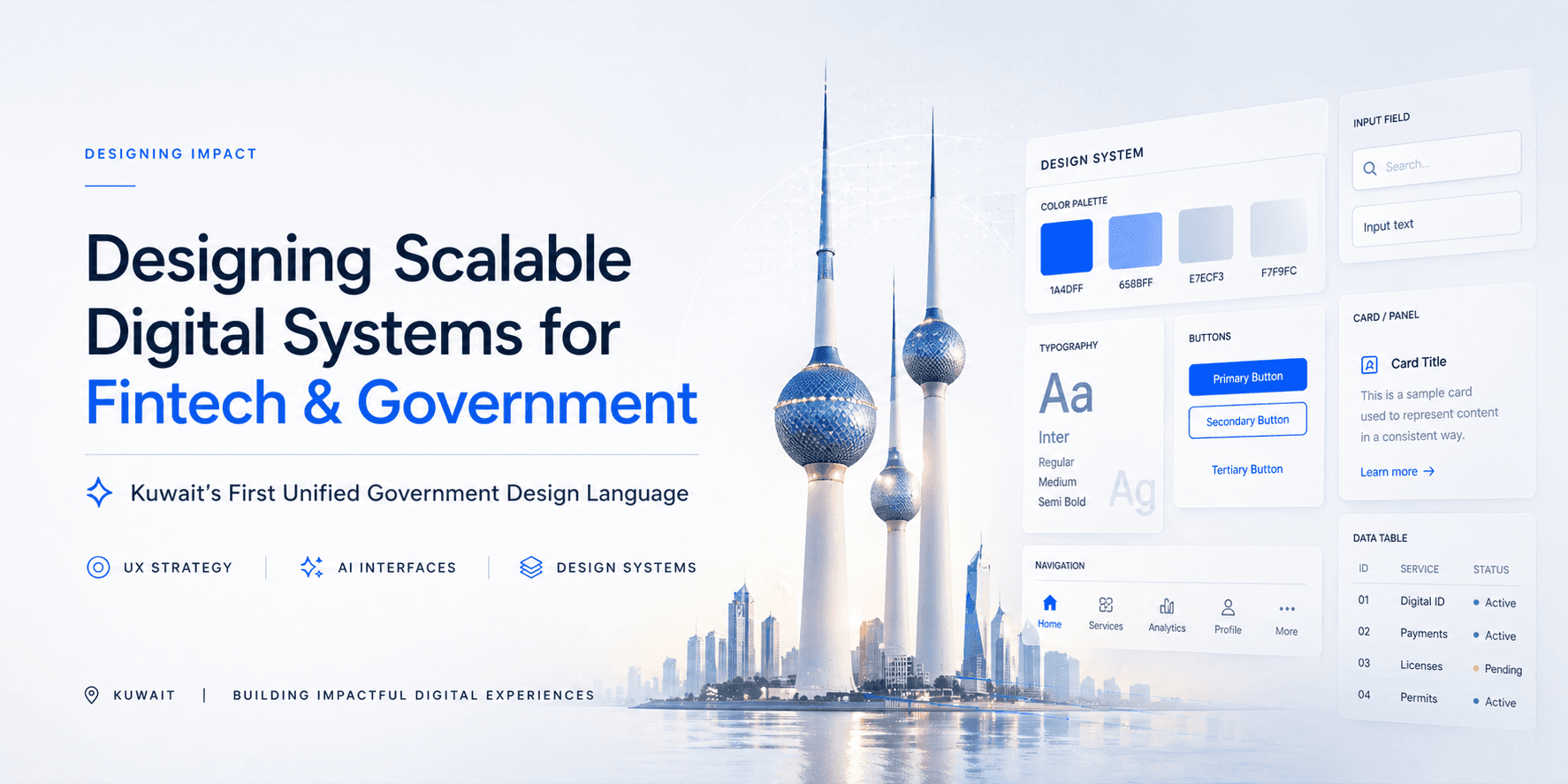
Kuwait has 10 years left to keep its promise.
In 2017, Kuwait launched Vision 2035 — Ru'iyat Al-Kuwayt — a national commitment to transform the country into a globally competitive, diversified, knowledge-based economy by 2035. Nine goals. One direction. A country betting on its own future.
Goal number five is the one that concerns every designer, every developer, and every citizen who has ever tried to renew their Civil ID online:
"The development of a transparent and interlinked government."
You can't have an interlinked government if every ministry looks, feels, and behaves like a completely separate organisation. You can't call it transparent if citizens can't navigate it. And you can't call it digital transformation if the web experience is still stuck in 2009.
This project addresses that gap — directly, and urgently.
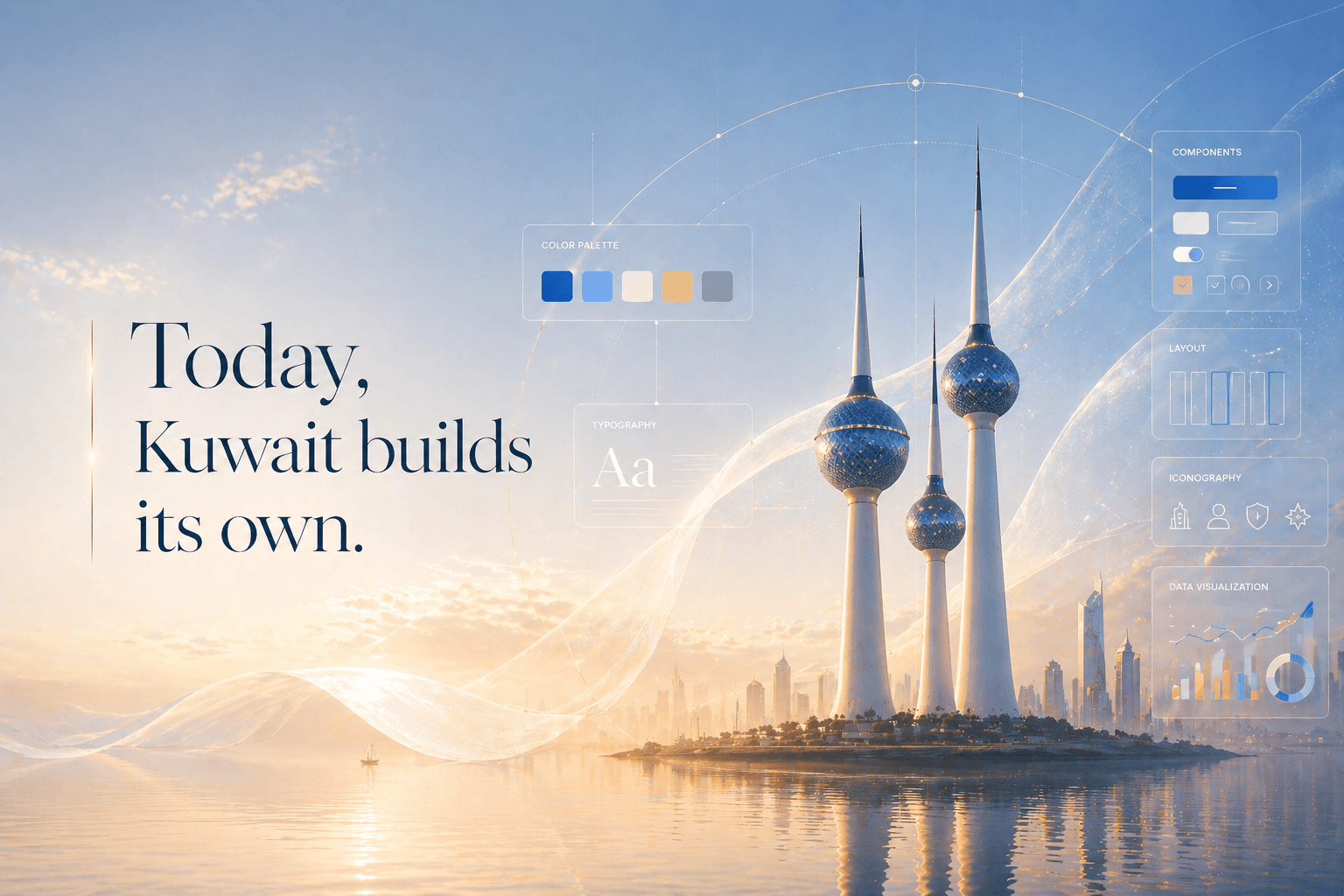
What "no design system" actually costs Kuwait.
I🔴 Citizens pay the price
Inconsistent navigation, inaccessible forms, and no bilingual standard mean every ministry feels like a different government. 76% of Kuwait government digital services were rated impossible to use for people with disabilities. That's not a design problem — that's a governance failure.
🔴 Ministries duplicate work
Without shared components, every government vendor rebuilds the same button, the same input field, the same card layout — from scratch, every project. Slower delivery. Higher cost. Zero consistency. Vision 2035 cannot scale on duplicated effort.
🔴 Vision 2035 slips
Goal 5 of Vision 2035 calls for a transparent and interlinked government. Interlinked means connected. Connected requires a shared design language. Without it, every new e-service adds to fragmentation, not unity. The vision gets harder to achieve, not easier.
One design system. Every ministry. One Kuwait.
The Kuwait Design System is the shared infrastructure that makes Vision 2035's digital government goal achievable — a unified design language for all Kuwait government digital services, built to be open, accessible, bilingual, and token-driven from the ground up.
Not a style guide. Not a PDF. A living, coded system of reusable components, design tokens, accessibility standards, and bilingual patterns — ready for any ministry, any vendor, any platform.

Built for scale. Designed for government.
The system is built on four primitive layers — Color, Typography, Spacing, and Shadow — all defined as CSS custom properties and Figma tokens, giving developers and designers a single source of truth that maps directly from design file to production code.
50+ production-ready components — each one built with government use cases in mind. Service cards, civil ID inquiry forms, accordion FAQs, steppers for multi-step applications, pagination for large service directories, toast notifications, modals, avatars, progress bars, and more.
"Vision 2035 calls for a transparent and interlinked government. You cannot interlink what was never designed to connect. The Kuwait Design System is the missing connective tissue."

2035 is closer than it looks.
Kuwait earns over 90% of its export revenues from oil. Vision 2035 exists precisely because that cannot last. Diversifying the economy means building a private sector that can compete — and a private sector can only compete if it's supported by a government that works efficiently, digitally, and consistently.
That means citizens accessing services without friction. Ministries deploying digital products without rebuilding the same button 40 times. Developers working with a shared language across every government touchpoint.
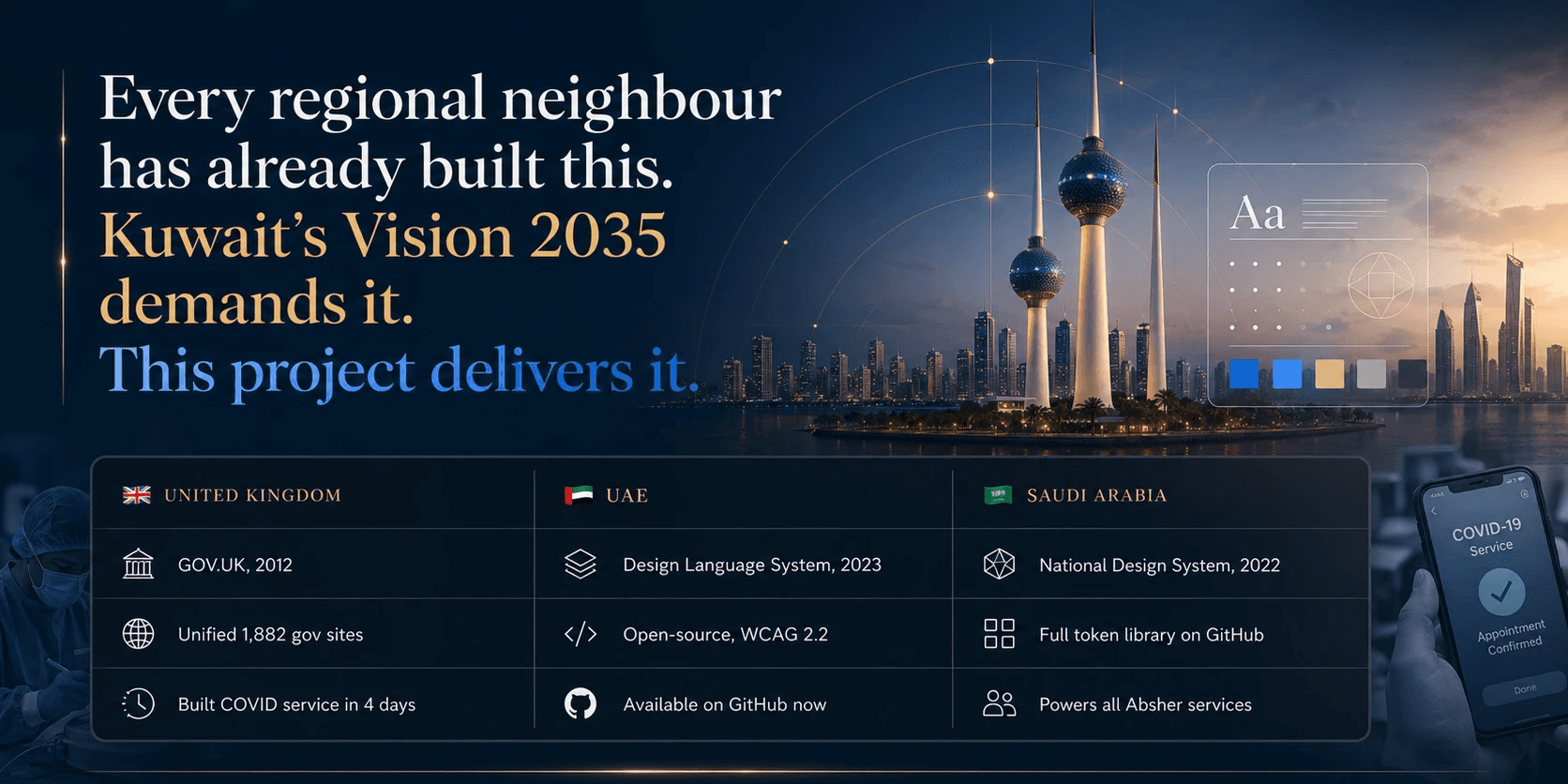
The UAE published its open-source Design Language System in 2023. Saudi Arabia launched the National Design System in 2022. The UK unified 1,882 government websites under GOV.UK in 2012 — and built a critical national COVID service in 4 days because they had the infrastructure ready.
Kuwait has Sahel — proof that unified digital government works here. 111 million transactions. 2.9 million Kuwaiti users. 460+ services in one place. Kuwaitis chose it because it felt like one government.
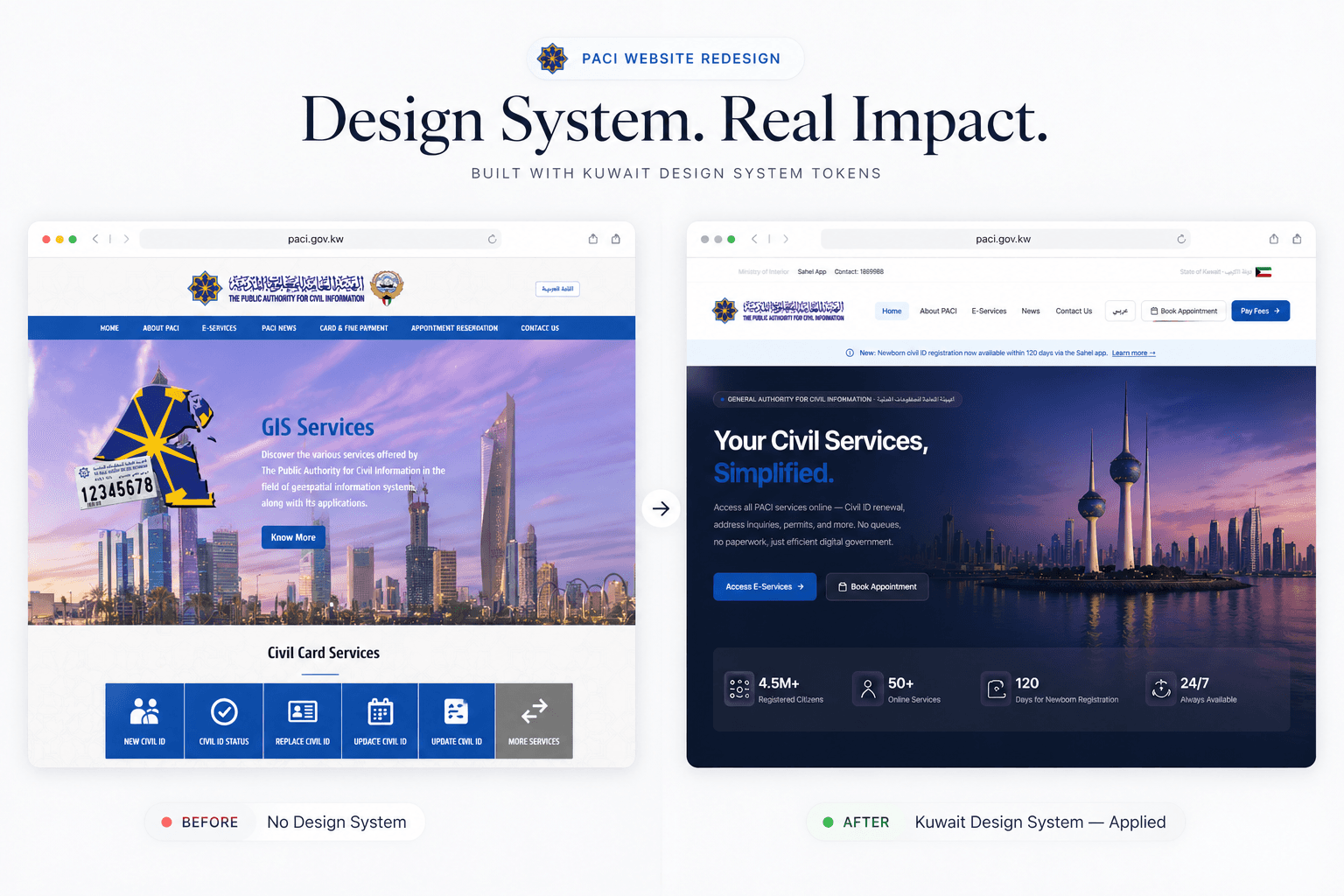
The web layer doesn't have that yet. This is it.
What I'd Do Differently
I'd push harder for access to real users earlier. Working through intermediaries gave me valuable insights, but I missed nuances that only come from watching someone actually struggle with an interface. Even one shadowing session would have accelerated my understanding.
I'd also document existing problems more systematically. I relied heavily on anecdotal feedback and support tickets, which worked—but a proper heuristic evaluation would have given me clearer evidence when advocating for changes.
What I Learned
Strategic improvements beat perfect overhauls. I wanted to rebuild everything into a sleek single-page experience. But given our constraints, that wasn't realistic. The three focused changes we made—progress visibility, auto-save, better IA—delivered serious value without requiring a ground-up rebuild.
Mental models beat logic. What made sense to me (grouping related data) didn't always match how therapists thought. Validating assumptions with people who actually do the work saved me from shipping something technically correct but functionally wrong.
Invisible design builds trust. The 'Last saved' indicator wasn't technically necessary—the system was auto-saving either way. But it transformed how people felt about the experience. Sometimes the most important design work is making invisible processes visible.
This is sample content for portfolio development purposes. Replace with your actual case studies when ready.